Cart
0

Why High-Achieving Professionals Need Precision Tailoring
Elite Wardrobe Strategy: How Premium Executive Tailoring Transforms Professional Image
The clothes you wear send a message before you speak. For executives and accomplished professionals, that message must align with your competence, judgment, and authority. Off-the-rack clothing rarely delivers this alignment because it's designed for average body proportions, not the specific dimensions and posture of a leader who commands attention.
Most high-performing professionals face a persistent friction point: nothing fit quite right. A suit jacket pulls at the shoulders. Trousers break unevenly. Shirt cuffs sit an inch too long. These small misalignments compound into a visual impression of carelessness, even when your work is meticulous. The mental burden of managing a wardrobe that doesn't work properly also diverts cognitive energy from your actual priorities.
Precision tailoring solves this directly. Rather than accepting compromise, you align your appearance with the authority you carry in your role. This isn't about luxury for its own sake. It's about eliminating the friction between how you think you look and how you actually appear to clients, boards, and teams. When your wardrobe fits with mathematical accuracy, you can stop thinking about it and focus on the work that matters.
The ROI extends beyond aesthetics. Research in organizational psychology shows that dress significantly influences both how others perceive you and how you perceive yourself. Executives who wear well-fitted clothing report greater confidence in high-stakes meetings and negotiations. They're also less likely to second-guess their grooming during critical moments. Precision fit becomes a kind of psychological armor.
The 23-Point Body Analysis Advantage
Most tailors measure five or six points: chest, waist, inseam, sleeve length, and maybe shoulder width. This approach treats the body as a generic template rather than a complex system of unique proportions. A 23-point body analysis changes that foundation entirely.
A rigorous 23-point system captures what makes your body distinct. It measures not just overall dimensions but the relationship between specific areas: how your shoulders relate to your chest, how your arm length compares to your torso, the exact angle of your posture, the depth of your chest, and dozens of other variables that standard tailoring ignores. This precision allows tailors to anticipate how fabric will drape across your unique frame.
Consider a practical example. Two executives may both wear a size 42 jacket. The first has broad shoulders with a deeper chest and a slight forward lean from desk work. The second has narrower shoulders, a flatter chest, and stands perfectly upright. A standard pattern fits neither perfectly. The 23-point approach identifies these differences and customizes the pattern accordingly, resulting in a jacket that moves with your body rather than against it.
The analysis also reveals postural patterns and imbalances. If your left shoulder sits slightly higher than your right (common among professionals who carry stress in one side), a proper analysis catches it. The resulting garment compensates, so you look balanced and composed rather than tilted. Your clothes adjust to you, not the other way around.
This level of detail eliminates the trial-and-error cycle. Rather than ordering a sample, trying it, requesting alterations, waiting weeks, and repeating the process, the precision analysis gets it right the first time. For busy executives, this efficiency is not a minor convenience. It's the difference between a streamlined process and a drawn-out ordeal.
Moving Beyond Off-the-Rack Limitations
Store-bought suits and dress shirts exist within rigid constraints. Manufacturers must produce thousands of units across five to eight standard sizes. They choose average proportions, assume average posture, and build in enough excess fabric to accommodate a broad range of bodies. The result? Most people feel like they're wearing something slightly wrong.
The limitations compound when you're an outlier in any direction. If you're particularly tall, trouser lengths consistently fall short. If you're athletic with a narrow waist and broad shoulders, jacket armholes sit too far back, limiting your range of motion. If you're broad-chested with a smaller waist, finding anything that fits both dimensions is nearly impossible. You end up purchasing the better-fitting piece and accepting compromise elsewhere.

Beyond fit, off-the-rack clothing limits your ability to create a coherent, intentional wardrobe. Each piece comes from a different manufacturer with different proportions, colors, and quality standards. When you try to build a professional capsule wardrobe from retail inventory, the pieces don't work together seamlessly. Charcoal grays don't match. Button styles clash. Fabric weights feel inconsistent.
Custom wardrobe design eliminates these constraints entirely. Every piece is conceived as part of a unified system, not a collection of individual purchases. Your tailored suits, dress shirts, trousers, and accessories are engineered to work together. Colors are calibrated. Proportions align across pieces. The fabrics complement rather than compete.
The practical outcome is a wardrobe where everything coordinates with everything else. You reach into your closet knowing that any combination will look intentional and polished. This eliminates decision fatigue on busy mornings and ensures you're always presenting the image you intend. For executives managing complex calendars and high-stakes appearances, this reliability matters.
Custom Fit as Professional Investment
Custom tailoring requires a significant upfront investment, typically ranging from $3,000 to $8,000 for a complete foundational wardrobe. For senior executives, this is material spending. The question becomes not whether you can afford it, but whether you can afford not to invest in this particular area.
The calculation hinges on two variables: cost of appearance-related friction and expected professional lifespan of the wardrobe. Consider the executive who spends thirty minutes each week managing a poorly fitting wardrobe, second-guessing choices, or dealing with wardrobe malfunctions. Over a career, that's hundreds of hours of cognitive energy diverted from high-value work. If your hourly rate is $200 or higher, the value of regaining that mental clarity justifies the investment alone.
A well-tailored wardrobe also extends the economic lifespan of clothing. Off-the-rack garments often look dated or worn after two years because they're constructed from cheaper materials and less durable stitching. Premium, bespoke pieces constructed from Italian fabrics and hand-stitched with attention to detail last five to seven years or longer. Spread across that timeline, the per-year cost becomes remarkably modest.
There's also the impact on client and board perception. Research in negotiation psychology shows that when one party appears significantly better dressed than the other, the well-dressed party holds a subtle but measurable advantage in terms of perceived credibility and authority. For executives closing deals, fundraising, or pitching to boards, this edge has direct financial value. A custom suit isn't a luxury accessory; it's a competitive tool.
Schedule a consultation with a tailoring expert to map out your specific wardrobe needs and investment timeline. Most professionals benefit from starting with three to four core pieces and expanding over time, rather than attempting a complete wardrobe replacement in one cycle.
The Streamlined Wardrobe Design Process
An expert-led custom wardrobe design process removes the guesswork from building a professional capsule wardrobe. Rather than making individual choices based on trends or impulse, you work with someone who understands proportion, color theory, and professional context.
The process typically unfolds in distinct phases. First comes the analysis phase, where your body is measured in detail using the 23-point methodology. Simultaneously, your lifestyle, role, and wardrobe goals are discussed. What's your dress code? How often do you present externally versus internally? Do you travel frequently? Are there color preferences or restrictions based on your industry or personal coloring?
Next comes fabric and style selection. A true expert guides you through premium options with specific recommendations rather than presenting every available choice. For example, rather than showing you thirty suit fabrics, your advisor narrows it to four or five that align with your coloring, professional context, and climate. This curation is essential. Too many choices paralyze decision-making; the right number of high-quality options moves the process forward decisively.
The custom try-on garment phase follows. Rather than ordering a final piece blindly, you receive a prototype garment constructed from your measurements and specifications. You wear it, move in it, and provide feedback. This touchpoint ensures that the final product accounts for comfort, mobility, and how fabric actually drapes on your body in real conditions. Many professionals discover during try-on that they prefer a slightly roomier chest or a different jacket length than they initially assumed.
Once feedback is incorporated, the final piece is constructed and delivered. This might take four to eight weeks, depending on complexity and the tailor's schedule. That timeline requires patience, but it's reasonable given the hand-stitched craftsmanship involved.

A quarterly wardrobe update recommendation rounds out the service. Rather than wondering whether you need a new blazer or how to refresh your look seasonally, your expert advises you on logical next additions. This prevents both the impulse purchases that clutter a wardrobe and the paralysis that leaves gaps.
Premium Fabrics and Hand-Stitched Craftsmanship
The difference between a $500 suit and a $3,000 suit lies largely in material quality and construction method. Understanding these differences helps you appreciate what you're investing in.
Premium Italian fabrics represent the pinnacle of men's tailoring material. Mills like Loro Piana, Ermenegildo Zegna, and Vitale Barberis Canonico have perfected the art of weaving superfine wools and luxury blends over centuries. A premium fabric might feature a tighter weave, higher thread count, and more refined fiber that drapes beautifully and wears longer without pilling or fading. The visual difference is subtle but noticeable. The garment looks more refined, moves more elegantly, and feels substantial in your hands.
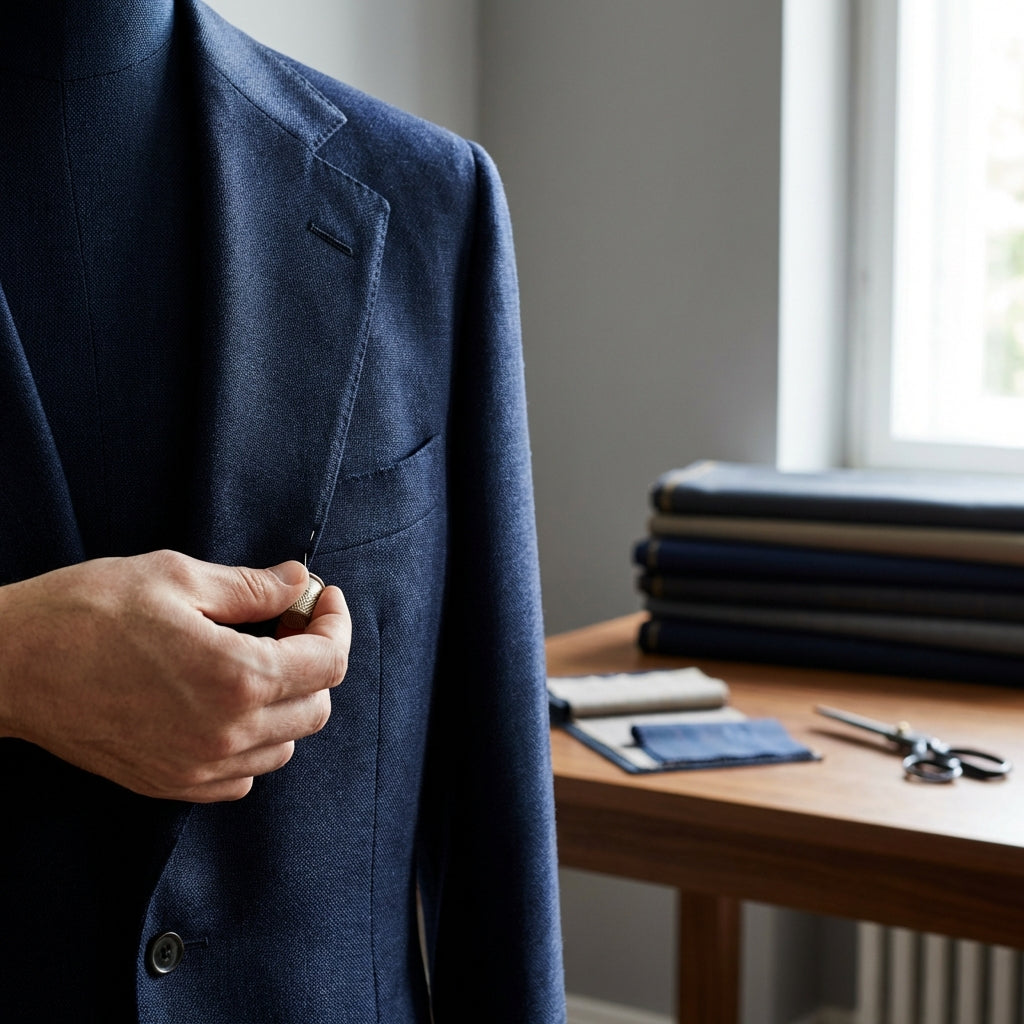
Hand-stitching versus machine construction represents the second critical difference. A machine can stitch a straight seam quickly and consistently. A skilled hand-stitcher, by contrast, uses variations in stitch length and tension to adapt to how the fabric naturally wants to move. This is particularly important at stress points like armholes, where the seam must accommodate constant movement without puckering or pulling. Hand-stitched work also allows for subtle adjustments that account for the grain of the fabric.
The visual and tactile result is a garment that moves with you rather than constraining you. A hand-stitched jacket drapes differently than a machine-stitched one. It settles on your shoulders with an ease that feels almost like the jacket is conforming to you, not the other way around.
Lining quality matters equally. Cheap suits use synthetic linings that trap heat and create drag when you move your arms. Quality bespoke tailoring uses natural fiber linings, often silk or linen blends, that regulate temperature and glide smoothly. You notice this during a full day of wearing. The garment stays comfortable throughout rather than becoming increasingly uncomfortable as the day progresses.
Construction methodology also affects durability. Hand-stitched seams can be re-stitched if needed; machine seams often cannot. This means a quality bespoke suit can be refreshed and maintained across many years. A button replacement, a seam reinforcement, or minor adjustments extend the garment's life significantly. This repairability is part of the long-term value proposition.
Building Your Personalized Digital Lookbook
Once your core wardrobe pieces are completed, a digital lookbook serves as your personal styling reference. Rather than relying on memory or Instagram inspiration, you have a curated collection of your own pieces arranged by outfit combinations, color pairings, and occasions.
A professional digital lookbook includes high-quality photographs of each garment individually and in combination. It documents which pieces work together, suggesting five-piece outfit combinations for different scenarios: board meetings, client lunches, internal presentations, and travel. Color swatches are included, showing exactly how your charcoal suit interacts with your navy blazer or how your dress shirts coordinate with ties.
The lookbook also functions as a reference during shopping for accessories. When you're considering a new tie or pocket square, you can reference your lookbook to see how it complements your existing pieces. This prevents the common trap of buying something beautiful in isolation that clashes with everything you own.
Most importantly, a lookbook eliminates daily decision-making. On a morning with a packed schedule, you open your lookbook, select an outfit combination, and move forward. No second-guessing. No "does this work?" uncertainty. You're wearing a combination that's been thoughtfully pre-validated.
Many professionals also share their lookbook with their tailor or wardrobe advisor for quarterly updates. Your advisor references it when recommending new pieces, ensuring that additions genuinely fill gaps rather than duplicating what you already own. This collaborative approach keeps your wardrobe cohesive and intentional over time.
Maintaining Your Executive Wardrobe Strategy

A custom wardrobe represents a significant investment that deserves proper maintenance. Unlike off-the-rack clothing, bespoke pieces reward careful stewardship with extended lifespan and consistent appearance.
Basic care starts with proper hanging and storage. Suits should hang on solid wooden hangers that support the shoulders fully. Avoid plastic hangers that create stress points. Store seasonal items in breathable garment bags rather than plastic, which traps moisture. Keep socks and accessories in designated drawers to prevent the frustration of searching for a matching pair on busy mornings.
Regular dry cleaning seems counterintuitive as maintenance advice, but overtouching your wardrobe damages it. Most professionals should dry clean a suit after five to seven wearings, not after each wear. A suit worn once doesn't need cleaning. Brushing lightly with a suit brush removes surface dust and restores fabric nap. Only when visible soiling appears should you send a piece for cleaning.
When dry cleaning is necessary, use a cleaner experienced with bespoke garments. Not all dry cleaners understand how to handle hand-stitched work or premium fabrics. A cleaner unfamiliar with these pieces might press seams too hard, damaging careful stitching, or use chemicals that dull fabric.
Seasonal rotation extends wardrobe life. Rather than wearing the same three suits year-round, rotate between seasonally appropriate pieces. This distributes wear across more pieces and reduces the frequency any single garment is cleaned. A suit worn once weekly will outlast the same suit worn three times weekly by several years.
Addressing small issues immediately prevents major problems. A loose button should be re-stitched before it becomes a lost button. A small snag should be carefully treated before it becomes a tear. This proactive approach keeps your wardrobe in excellent condition without expensive repairs.
Your tailor should become a long-term partner in this maintenance. Regular check-ins allow for minor adjustments as your body changes, reinforcement of stress points before they tear, and recommendations for seasonal cleaning and storage. Many tailors offer annual or bi-annual wardrobe audits where they inspect each piece, note necessary repairs, and recommend refreshes.
Showing Up With Authority and Confidence
The final measure of a custom wardrobe is not how you feel in private but how you show up in moments that matter. When you're walking into a boardroom for a critical negotiation, a shareholder meeting, or a client presentation, your appearance communicates something before you speak.
Precision fit and premium craftsmanship combine to create a visual presence that reads as composed, intentional, and authoritative. You're not tugging at cuffs or adjusting a jacket that doesn't quite sit right. You're not wondering whether your outfit looks cohesive or whether a button might pop. These micro-uncertainties vanish when you wear something that's been engineered precisely for your body.
This is the psychological dimension of bespoke tailoring that extends beyond aesthetics. Research in embodied cognition shows that how you wear your clothes influences how you think and perform. When your clothing fits perfectly and allows unrestricted movement, you unconsciously assume a more confident posture. Your breathing deepens slightly. Your shoulders relax. These physical shifts translate into measurable differences in communication, decision-making, and presence.
Consider the executive preparing for an IPO roadshow. She'll be on her feet for hours, presenting to investors in different cities. A custom wardrobe means every piece is lightweight but structured, mobile but professional, and color-coordinated for visual consistency across the week. She's not managing wardrobe friction; she's maximizing her ability to focus on the message she's delivering.
Or the partner preparing for client-facing work in a highly competitive market. His custom suits communicate that he's serious about his appearance and, by extension, his work. When both parties are similarly dressed, the one who appears more polished holds an intangible but real advantage in how others perceive competence and trustworthiness.
This isn't about fashion or vanity. It's about eliminating a variable that shouldn't exist. When your wardrobe works perfectly, you reclaim mental energy and project the authority that your role demands. You stop thinking about it and start being fully present in the moments where presence matters most.
Explore how bespoke tailoring can support your professional goals by connecting with Donovan England bespoke tailoring to discuss your specific wardrobe needs and vision.
Schedule your Complementary Wardrobe Review Call