Cart
0

Achieving the Perfect Fit with Precision Body Analysis
Top 7 Best Reasons to Transition from Off-the-Rack to Bespoke Tailoring
Off-the-rack clothing follows a one-size-fits-most formula. Most executive professionals who've worn the same labels for years eventually discover the hard truth: those pieces were never designed for your specific proportions. An executive with broad shoulders might drown in a standard 42R. Another with a longer torso perpetually tugs at jacket hems. The frustration compounds when you realize no amount of alterations will deliver what you actually need: a garment engineered from the ground up for your exact measurements and frame.
This is where bespoke tailoring changes the equation. Rather than conforming your body to clothing, custom tailoring conforms clothing to you. The shift from off-the-rack to a tailored wardrobe isn't simply about looking better, though that follows naturally. It's about recalibrating your entire relationship with getting dressed, investing in pieces that actually work, and showing up the way you're expected to without a second thought about fit or proportion.
Below are seven concrete reasons why accomplished professionals make this transition, and the practical advantages that follow.
A proper fit starts with precise measurement. Off-the-rack garments rely on statistical averages across thousands of bodies. Standard jacket sizes assume predictable proportions between shoulder width, sleeve length, and torso drop. Yet your body is rarely predictable in that way. Perhaps your arm length outpaces your jacket length. Perhaps your shoulders sit higher or lower than the norm. These variations are completely normal and completely invisible to mass manufacturing.
Bespoke tailoring begins with a rigorous 23-point body analysis. This isn't casual measuring tape work. It captures your shoulder slope, bicep circumference, wrist position, torso length, and dozens of other reference points that define how fabric will hang on your frame. Each measurement informs pattern adjustments at the cutting stage, long before needle meets cloth.
The outcome is tangible. A suit jacket drapes without pulling at the chest. Sleeves break at your wrist exactly as intended. Trousers sit at the correct rise without bunching at the hip or breaking awkwardly at the ankle. Armholes allow full movement without baggy fabric pooling under your arm. This isn't fine-tuning. It's foundational engineering that mass production simply cannot match.
Consider the practical impact. You spend less time adjusting your clothing throughout the day. No more tugging sleeves or worrying whether your posture is shifting the fit. The precision translates directly into confidence, because the garment becomes invisible to you. You're not thinking about whether it fits. You're thinking about the work in front of you.
What to do next: Document your current fit frustrations with off-the-rack pieces. Do sleeves consistently ride up? Does the jacket pull across the chest when you sit? These observations clarify what a precision analysis will solve.
Building Confidence Through Wearing Authority
Confidence has a visible component. It shows in posture, in the ease with which you move, in whether you're subconsciously adjusting your clothes every few minutes. A suit that doesn't fit cuts that confidence in half. You become hyperaware of the gaps, the pulls, the compromises. Your energy goes toward managing the garment rather than commanding the room.
Wearing authority is different. It's the unspoken signal you send when every element of your appearance reinforces your professional position. The jacket sits cleanly across your shoulders because it was cut to your shoulder width. The trousers break precisely at your shoe because they were measured to your exact inseam. The proportions feel right because they were engineered specifically for your body, not adjusted after the fact to approximate a fit.

This isn't vanity. High-achieving professionals understand that appearance influences perception, and perception influences outcomes. A well-fitted suit doesn't make you smarter or more capable. It removes a friction point. Your client, your board, your colleague sees someone who is put together, intentional, and commanding. They see someone who didn't leave this detail to chance.
The psychological shift matters too. When you know your suit was precision-engineered for your frame, you wear it differently. You sit taller. You move with less self-consciousness. The garment becomes an extension of your authority rather than a source of low-level friction. Over time, that compounds. You show up more consistently as the version of yourself you intend to present.
What to do next: Notice over the next week how often you adjust off-the-rack clothing. Track whether those moments of adjustment correlate with lower confidence in high-stakes situations.
Investing in Hand-Stitched Craftsmanship and Quality
Hand-stitched tailoring represents a fundamentally different production standard. Industrial sewing machines can produce a seam quickly. A skilled tailor with needle and thread produces something more durable. The stitches are variable in tension and spacing, which creates a seam that flexes with the fabric rather than against it. This flexibility means the seam lasts longer and moves more naturally with your body.
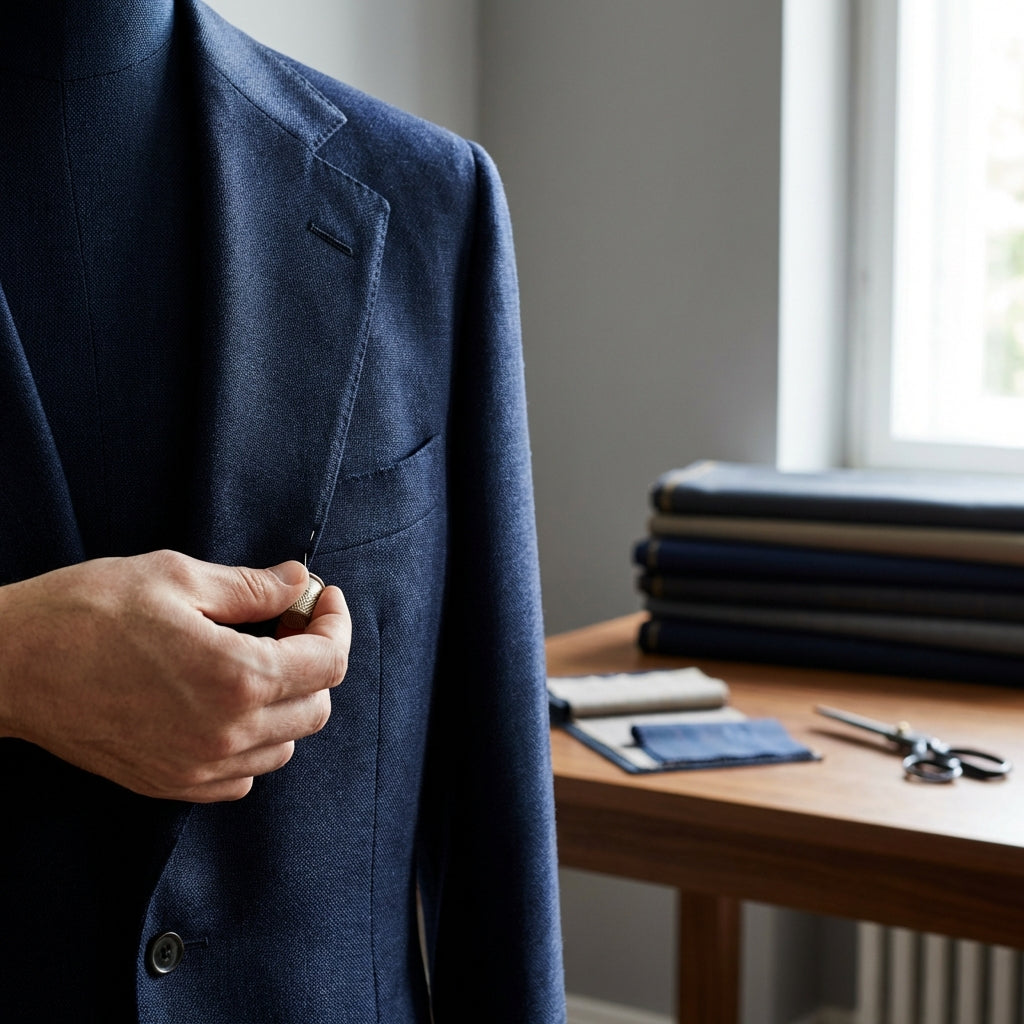
The difference extends beyond the seam. Hand-finished work includes details that machines simply cannot replicate. Lapels are rolled by hand to create a specific curve and drape. Button holes are sewn and finished with precision that accounts for how the fabric will age. Collar stands are shaped to conform to your neck rather than a generic form. These details are invisible to most observers, but they determine whether a suit looks handmade or manufactured.
Quality in bespoke work also means material choice. Inferior fabrics can be damaged during construction. A low-twist wool will pill and wear prematurely no matter how skillfully it's sewn. Premium Italian fabrics, sourced for durability and hand-feel, allow craftsmanship to shine. The combination of quality fabric and hand-stitched construction means your suit will age gracefully rather than deteriorate.
The longevity equation is worth calculating. A mass-produced suit costs perhaps 800 to 1,500 dollars and lasts four to five years before it no longer holds its shape. A bespoke suit constructed with premium fabrics and hand-stitched seams costs substantially more upfront but remains wearable for 10 to 15 years with proper care. The cost per wear drops dramatically, and you're wearing garments that actually improve with age.
What to do next: Examine a suit you've worn for three years. Look at the seams, the fabric surface, and the button holes. This is your baseline for what mass production degradation looks like.
Sourcing Premium Italian Fabrics for Your Collection
Fabric quality separates casual tailoring from bespoke work. Off-the-rack brands source fabrics based on cost efficiency. A mill might produce acceptable wools in bulk, knowing those fabrics will be worn for two to three seasons before the garment is discarded or donated. This creates no incentive for durability or hand-feel.
Bespoke tailors work with mills that prioritize different criteria. Italian fabric mills, in particular, have built their reputation on textiles that age beautifully and handle exceptionally well. A premium Italian wool has a tighter weave, richer hand-feel, and superior resistance to creasing. The fabric breathes, drapes with intention, and develops a subtle patina as you wear it over years.
The fabric sourcing process itself differs from retail. Rather than selecting from a fixed catalog, a bespoke tailor maintains relationships with mills and can often specify custom options. You might select a base wool weight and weave, then choose a specific dye lot to ensure your suit has color depth that reads differently in different light. This level of customization creates a garment that is genuinely one-of-a-kind, not simply a unique fit on a standard fabric.
Different fabrics serve different purposes in a professional wardrobe. A charcoal suiting with a subtle twill holds structure and commands authority in formal settings. A medium-weight navy in a softer weave works for client meetings where you want to appear accessible and collaborative. A textured gray supports both situations with understated versatility. A bespoke tailor helps you select fabrics that align with how you actually dress and the environments where you spend your time.

What to do next: Run your fingers across your current suits and compare them to Italian fabrics (available at quality fabric retailers). Notice the difference in weave density and natural feel.
Streamlining Your Wardrobe with Expert-Led Curation
Most professionals outfit themselves through a combination of shopping impulses, seasonal sales, and trend chasing. Over time, this produces a closet with mixed quality, inconsistent color palettes, and pieces that don't coordinate well. Getting dressed requires negotiation because your options don't work together seamlessly. You reach for the same three combinations repeatedly because the rest of the closet feels disjointed.
Expert-led curation takes a different approach. Rather than shopping, you plan. A bespoke tailor works with you to audit your lifestyle and professional environment, then recommends a core collection of pieces that actually function together. These aren't trend pieces. They're foundational garments that will remain relevant for a decade.
A streamlined collection might include two or three suits in core colors (charcoal, navy, and perhaps a versatile gray), dress shirts in complementary shades, and trousers in neutral tones that mix across suiting. Each piece is designed to combine with others, so you have far more outfit combinations than pieces. You also eliminate waste. You're not buying pieces that sit unworn because they don't coordinate. Every item earns its place.
The time savings compound. Getting dressed in the morning requires fewer decisions because your wardrobe is curated, not cluttered. You grab from a collection you trust, and you know the result will work. Over a year, this saves hours of decision-making friction. More importantly, it ensures you consistently present yourself at the standard you've set, because your wardrobe actually supports that standard.
Consider also the financial clarity. Rather than spreading budget across numerous impulse purchases, you invest in fewer, higher-quality pieces designed for longevity. The cost per item is higher, but the cost per wear is lower, and the reliability is infinitely better.
What to do next: List the outfits you actually wear in a typical week. Identify gaps and overlaps. Chances are a third of your closet never appears in that list.
Maintaining Your Look with Quarterly Update Recommendations
Your body and lifestyle change. You gain or lose weight. Your role evolves, requiring different professional contexts. Fabric wears and softens. What worked perfectly five years ago may no longer fit or suit your current situation. Off-the-rack dressing offers no mechanism to manage this evolution. You simply buy new pieces and hope they work better.
Bespoke tailoring includes ongoing relationship management. Quarterly update recommendations mean your tailor reviews your wardrobe needs and proposes additions or modifications that keep your collection current and functional. Perhaps you've been promoted into more formal settings, and a formal evening suit would add versatility. Perhaps you've taken on client-facing responsibilities in less formal environments, and a sport coat in a more approachable fabric would serve you well. Perhaps a favorite jacket has softened with wear and could be complemented by a new piece in a similar style.
This isn't about chasing trends. It's about ensuring your wardrobe evolves with your actual life. You're not managing the update process yourself. Your tailor handles it, drawing on their experience of what works and what doesn't for professionals in your position. You receive recommendations, consider them with the expertise and context you have, and decide what makes sense.
The process also catches fit issues before they become problems. If a suit has relaxed slightly with age, a tailor can assess whether it's still appropriate or whether replacing it makes sense. If your measurements have shifted, adjustments can bring a favorite piece back into perfect proportion. Regular touchpoints prevent the slow slide into a closet that no longer actually serves you.

What to do next: Schedule a wardrobe review with someone whose judgment you trust. Ask them what's missing or what feels dated about your current collection.
Enjoying the Convenience of Global Shipping and Home Service
Bespoke tailoring traditionally required travel to a tailor's studio. For accomplished professionals, this represents significant friction. Time away from your work, coordination of schedules, and travel logistics make the process feel burdensome rather than streamlined.
Modern bespoke services have eliminated this friction. Measurements can be taken in your home or office, eliminating travel time. Your try-on garment can be shipped to you for fitting in your own environment, where you can assess how it works with your actual schedule and space. Final adjustments are made based on feedback from that real-world context rather than assumptions made in a studio setting. The completed garment arrives at your door, ready to wear.
This convenience extends internationally. If you travel frequently or work across multiple cities, global shipping means your bespoke pieces follow you. You don't need to maintain separate wardrobes in different locations. You build one collection that travels with you, because consistent fit and quality mean your pieces work the same way everywhere.
The efficiency also changes how you think about wardrobe investment. Because the process isn't burdensome, you're more likely to maintain your collection thoughtfully. You can add pieces incrementally as your needs evolve, rather than feeling pressured to build everything at once. This distributed approach spreads investment over time and prevents the closet overwhelm that comes from a major wardrobe overhaul.
Home-based service also means your measurements are taken in the clothing you actually wear and the lighting you actually see. This creates more accurate assessment of how new pieces will integrate into your existing life. A tailor measuring you in a studio isn't seeing you in the office light where you spend most of your time. A measurement taken in your home or office provides context that improves fit and reduces surprises when the finished piece arrives.
What to do next: Calculate the time and cost you spend annually on clothing shopping and wardrobe management. This is the friction that bespoke tailoring eliminates.
---
The transition from off-the-rack to bespoke tailoring isn't complicated once you understand what you're actually paying for. You're purchasing precision engineering, quality craftsmanship, and expert curation applied to your specific body and lifestyle. You're eliminating the friction of clothing that doesn't fit, doesn't last, and doesn't coordinate. Most importantly, you're reclaiming the mental and temporal space currently consumed by wardrobe management and clothing adjustment.
These advantages compound. The time you save getting dressed multiplies across years. The confidence you gain from precision fit shows up in client interactions and internal presence. The investment in quality means your pieces serve you longer and better than anything off-the-rack could match.
If you've outgrown standard retail clothing and never found a tailoring solution that actually worked, bespoke tailoring addresses exactly that gap. Donovan England specializes in precisely this transition for accomplished professionals. The process begins with understanding your current frustrations and your actual wardrobe needs, then delivers a collection engineered to eliminate both.
The better fit you wear, the better you show up. That's not marketing. That's simply how confidence works.
Schedule your Complementary Wardrobe Review Call