Cart
0
Understanding the Core Difference Between Bespoke and Made-to-Measure
Bespoke vs Made-to-Measure Suits: A Guide for American Executives
The distinction between bespoke and made-to-measure tailoring often gets blurred in casual conversation, but the difference is precise and consequential. Bespoke tailoring starts from zero: the tailor drafts a pattern entirely from your body measurements, creates a test garment for fitting, and builds your suit from that custom block. Made-to-measure begins with an existing pattern template, adjusted to accommodate your proportions. Think of bespoke as architecture from the foundation up; made-to-measure as renovation of a proven floor plan.
Neither approach is inherently superior. The choice depends on your body type, timeline, budget, and how demanding your fit requirements are. A perfectly proportioned frame might achieve excellent results with made-to-measure efficiency. An executive with unusual proportions, previous fitting disappointments, or exceptionally high standards often finds that only a bespoke process delivers the precision required.
The cost difference is substantial. Bespoke typically ranges from $3,500 to $8,000 per suit due to the labor-intensive pattern drafting and multiple fittings. Made-to-measure generally falls between $1,200 and $3,500, depending on fabric and customization depth. Turnaround time also differs: bespoke usually requires 10 to 14 weeks, while made-to-measure can often be completed in 6 to 8 weeks.
What matters most is whether the garment fits your body perfectly and allows you to show up the way you're expected. Everything else serves that singular outcome.
Why Body Analysis Matters in Custom Suiting
Off-the-rack suits are cut to statistical averages, not individual bodies. An executive standing 6'2" with sloping shoulders and a longer torso than average will find that standard sizes pull awkwardly, bunch at the back, and require significant alterations that compromise the garment's integrity. This is where precision body analysis becomes non-negotiable.
A rigorous measurement protocol captures more than just chest and inseam. A 23-point body analysis, for instance, documents shoulder width, drop (the difference between chest and waist), pitch (forward lean), sleeve length from multiple reference points, torso length, thigh circumference, and nuances like arm hole depth and neck proportions. Each measurement informs how fabric will drape and move on your frame.
Consider a typical scenario: an executive notices his jackets gape at the back neck or pull across the shoulders when he extends his arms. Neither issue is correctable through standard tailoring without compromising silhouette. Bespoke tailoring, informed by detailed body analysis, would adjust the armhole, shoulder seam placement, and back pitch to accommodate his actual structure. The result feels like the garment was built for him, not altered to fit him.
This analysis also serves as your baseline. When you're recalibrating your wardrobe or ordering additional pieces, having a precise body map means consistency across multiple suits, regardless of fabric weight or fabrication changes.
The Bespoke Advantage: Full Customization and Precision
Bespoke tailoring offers control that made-to-measure cannot match. You're not constrained by an existing pattern block's assumptions about how sleeve length should relate to armhole depth or how back balance should be proportioned. Every structural element can be customized to your exact specifications.
This matters most for executives with non-standard proportions. A client with broad shoulders but a short torso, or unusually long arms relative to his height, will struggle with standard patterns no matter how skillfully they're adjusted. Bespoke allows the tailor to build a pattern that respects his actual proportions from the first draft.
The fitting process itself is more thorough. Rather than one fitting before final production, bespoke typically includes a first fitting of the test garment (or "muslin"), adjustments based on observations, and sometimes a second fitting of the near-final garment. This iterative approach catches subtleties that single-fitting methods can miss: how the jacket sits when you're seated in a meeting, the break of the trouser on your shoe, the way the collar lies when you turn your head.
Customization extends beyond fit. You can specify button placement, pocket depth, lapel width, functioning buttons on jacket sleeves, and details like whether your trousers have side tabs or a center vent. These aren't frivolous choices; they affect how the garment photographs, how it feels, and whether it aligns with your personal aesthetic.
The downside is time and financial commitment. You're investing not just in materials but in craftsmanship hours. For an executive managing a demanding schedule, the extended timeline requires planning ahead.
Made-to-Measure: Streamlined Excellence for the Executive
Made-to-measure tailoring delivers precision without the timeline or cost of bespoke. The process is more efficient: your measurements are plugged into a tested pattern system, the pattern is adjusted proportionally, and production begins with one fitting checkpoint. This streamlined approach makes sense for executives who have standard proportions, value speed, or need multiple suits in a condensed timeframe.

The quality doesn't suffer from this efficiency. A well-made made-to-measure suit, constructed from premium fabrics with proper hand-stitching and finishing, will serve you with confidence and durability. The key is working with a tailor who uses robust pattern systems and doesn't sacrifice fit or construction quality to accelerate the timeline.
Made-to-measure is also more forgiving of minor changes. If you've slightly gained or lost weight since your initial measurements, a tailor working with an existing pattern can sometimes adjust more flexibly than a bespoke pattern allows. The pattern template provides a reliable foundation that can absorb incremental adjustments.
For many executives, made-to-measure represents the practical sweet spot: better fit than off-the-rack, faster delivery than bespoke, and significantly lower cost without compromising the essential elements of precision tailoring. You're choosing excellence in fit and construction; you're simply not paying for every possible structural customization.
Evaluating Your Specific Needs and Lifestyle
Your choice between bespoke and made-to-measure should rest on honest assessment of three factors: your body type, your timeline, and how much precision you genuinely need.
If you've spent years in off-the-rack suits that required significant alterations, struggled with fit in shoulders or back, or noticed that you're outgrown what standard tailoring can deliver, bespoke is worth the investment. These signals indicate that your proportions fall outside the statistical norms that made-to-measure patterns assume.
If you're building or refreshing an entire wardrobe and need multiple suits quickly, made-to-measure allows you to establish several pieces without waiting 14 weeks for the first garment. Many executives prefer ordering two or three made-to-measure suits over six weeks rather than waiting three months for one bespoke piece.
Timeline matters practically. If you have a major presentation, client engagement, or role transition within two months and you're nothing fit, made-to-measure gets you suited appropriately in time. Bespoke is a more deliberate choice for long-term wardrobe investment.
Budget flexibility also shifts the equation. Allocating $5,000 once for a bespoke foundational suit might be wiser than spreading that budget across three lower-quality made-to-measure pieces. Conversely, if you need five suits and your budget is $7,500, made-to-measure allows you to build a cohesive wardrobe rather than owning a single exceptional piece.
Honestly assess how much of your week is spent in formal suiting and how visible your image is in your role. An executive who appears on video calls, meets clients regularly, or is frequently photographed benefits more from perfect fit than someone who suits up occasionally for quarterly board meetings.
The Investment Factor: Cost and Long-Term Value
Custom tailoring is an investment, and like all investments, it makes sense only when the return is clear. A $4,000 bespoke suit sounds expensive in isolation; over five years of regular wear, that's $800 annually, or roughly $3.08 per wearing if you wear it 260 times. That math only works if the suit actually lasts and if the fit justifies the expense.
Made-to-measure suits at $2,000 to $2,500 follow similar logic. The per-wearing cost is lower, but the value proposition is the same: you're paying for fit, materials, and craftsmanship that won't deteriorate quickly or leave you reaching for an ill-fitting alternative.
What drains value is buying a suit that doesn't fit well enough to wear confidently, regardless of the price. An executive who owns five $3,000 suits but gravitates toward his one $2,500 bespoke piece because it fits perfectly is overspending on the others. The fit is the primary variable that determines whether a suit actually gets worn and justifies its cost.
Consider also the secondary benefits. A suit that fits precisely requires less maintenance and alteration over time. A suit that fits poorly is often altered repeatedly, damaging the integrity of the seams and fabric. A well-fitted suit also signals competence and attention to detail in professional contexts, which has tangible career implications.
The real calculation isn't cost per suit. It's whether the suit enables you to show up with the confidence and authority your role demands, and whether it will hold up to the frequency of wear you're committing it to. That context determines whether $2,000 or $5,000 is actually the economical choice.
The Try-On Process: Ensuring Perfect Fit Before Production
This is where bespoke and made-to-measure diverge operationally. Both processes include a try-on checkpoint; the depth and rigor differ.
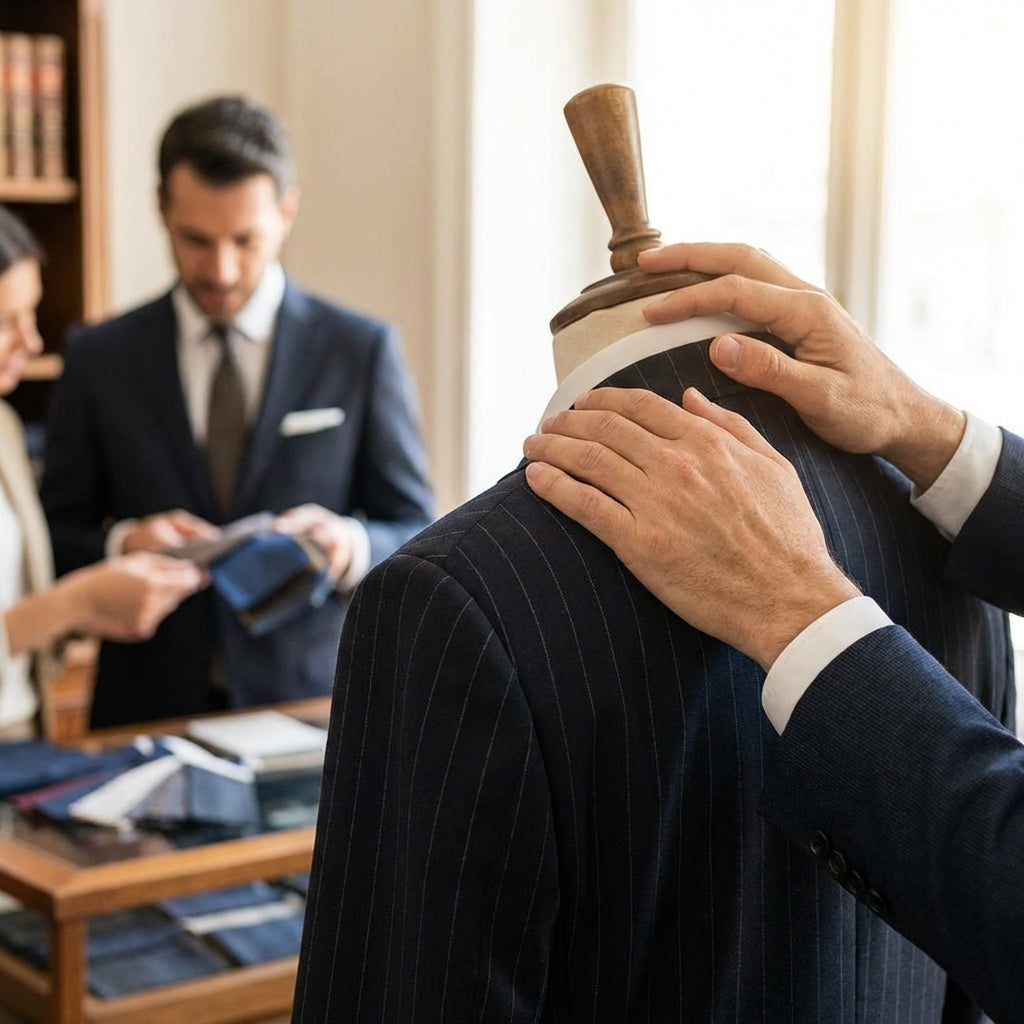
In a traditional bespoke process, you're fitting an unfinished muslin test garment weeks before final construction. The tailor observes how it sits on your shoulders, whether the armhole restricts movement, if the back pitch accommodates your posture, and where the jacket breaks over your torso. Based on these observations, the pattern is refined. You may return for a second fitting of the near-final garment before the suit goes into full production.
This iterative approach is valuable because it catches issues early. If the test garment reveals that you need more room in the chest or a shorter jacket length, those adjustments are made to the pattern before expensive suiting fabric is cut. It also allows you to experience the garment and provide feedback that might not surface in a static measurement conversation.

Made-to-measure fitting is typically condensed into one or two checkpoints. Your measurements inform the initial pattern, a sample or first cutting is tried on, and final adjustments are made before the garment is finished. This works well when the pattern system is robust and your proportions align reasonably with the baseline assumptions.
The difference in experience matters. Some executives appreciate the dialogue and refinement that bespoke fittings allow. Others find one thorough fitting sufficient and value the speed it provides.
What's non-negotiable is that you have an opportunity to see and feel the garment before it's finalized. Never commit to a suit you haven't tried on, even if measurements are perfect on paper. Fit is tactile; it changes when you move, sit, and gesture. A try-on process ensures you have conviction before investment.
Sourcing Premium Materials and Italian Fabrics
The quality of your suit depends partly on cut and partly on materials. Premium suiting fabrics make a material difference in how a garment looks, feels, and wears over time.
Italian mills produce some of the world's finest suiting textiles. Fabrics from makers like Loro Piana, Vitale Barberis Canonico, and Scabal are woven with precision that affects how the cloth drapes, how it resists wrinkles, and how it responds to hand-pressing. A suit in a premium Italian wool will hold its shape differently than an equivalent suit in a commodity wool; the difference is visible and felt.
The weight matters. A 10-ounce fabric feels and wears differently than a 13-ounce fabric. Lighter weights provide a more refined silhouette and are appropriate for mild climates; heavier weights offer structure and insulation. For an American executive building a core wardrobe, a range of weights ensures you're not overheating in May or underdressing in October.
When selecting fabric, clarity on intended use guides the choice. A suit destined for boardroom appearances and client dinners demands a fabric with presence and permanence: a medium-weight wool in a restrained pattern or solid color. A suit intended for travel can benefit from higher wool percentages or blends that resist wrinkles and recover quickly.
The sourcing process varies. Some tailors maintain direct relationships with mills and offer a curated selection. Others work with agents or brokers who compile libraries of available textiles. The best approach is one where you can see and feel the fabric before committing, and where the tailor can articulate why a particular cloth is appropriate for your use case.
Premium doesn't always mean the most expensive option. It means appropriate materials selected with intention. A well-sourced 12-ounce wool in a practical color serves you better than an exotic fiber that requires delicate care and limits versatility.
The Hand-Stitched Difference in Craftsmanship
Machine stitching is efficient and consistent. Hand-stitching is deliberate and responsive. The distinction affects durability, appearance, and the long-term wearing experience of your suit.
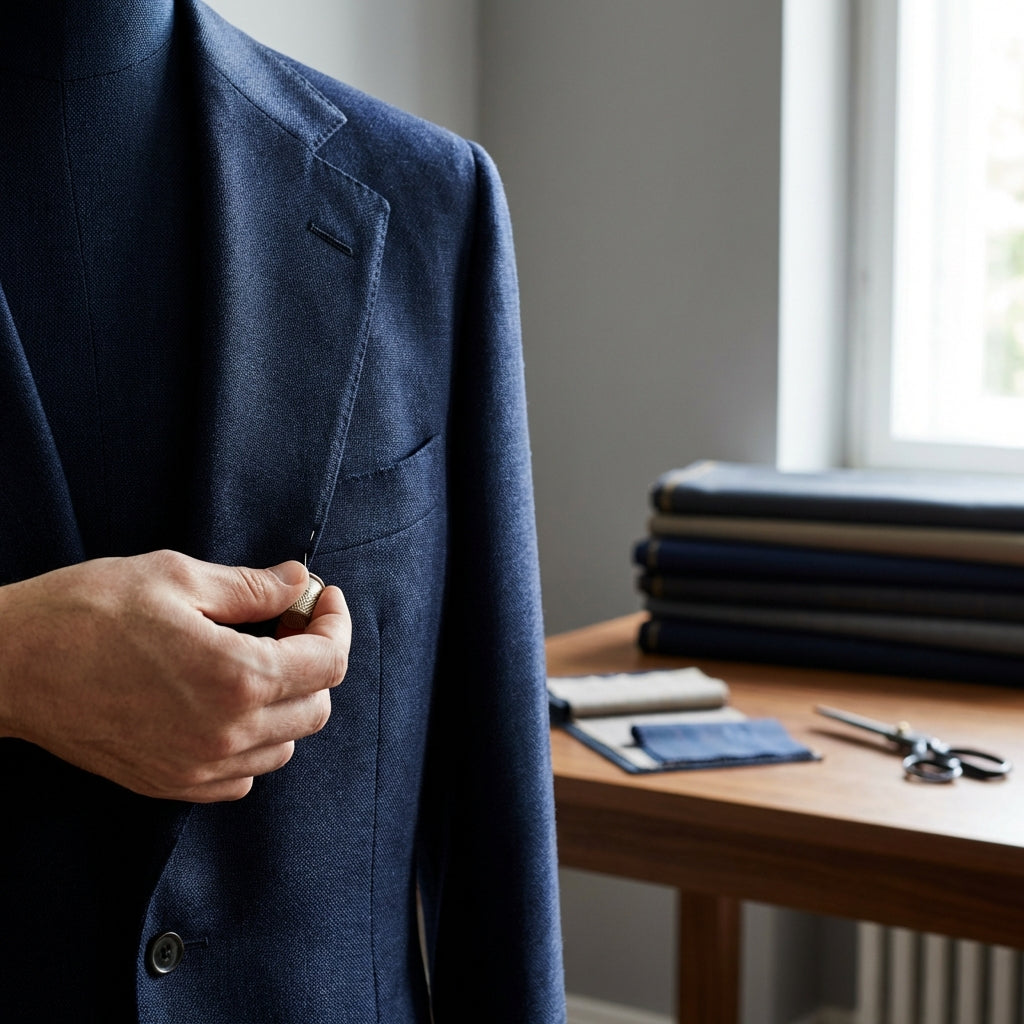
Critical seams on premium custom suits are hand-stitched: the shoulder seam, the side seams, and the attachment of the collar. Hand-stitching allows the tailor to adjust tension, accommodate fabric variations, and respond to the weight and behavior of the specific material. On a premium suiting fabric with subtle nap or weave, this responsiveness results in seams that lie flatter and straighter than machine alternatives.
The buttonholes are similarly executed by hand on quality garments. A hand-finished buttonhole has a slight texture and subtle character that machine buttonholes lack. More importantly, hand-finished buttonholes are less prone to fraying and hold up better to repeated use over years of wear.
Interior construction also signals quality. Chest pieces, lapel reinforcements, and inner pocket bags on premium suits are often pad-stitched by hand, creating a subtle texture that's nearly invisible but contributes to how the jacket moves and recovers. These details don't create visual difference in the finished garment, but they affect how the suit performs and how long it retains its shape.
Hand-stitching inherently requires time. A master tailor can hand-stitch approximately 50 to 100 seam inches per hour, depending on the complexity. That translates to material labor investment. But that investment shows in how a suit wears: seams don't unravel or separate, fabric doesn't pucker at stress points, and the garment maintains its integrity and appearance through frequent use and professional cleaning.
This isn't an upsell tactic. It's a factual difference in construction that directly affects whether your suit will serve you reliably for five years or begin showing wear after two.
Building a Custom Wardrobe Strategy
A single perfect suit is valuable. A coordinated wardrobe of custom suits is exponentially more powerful. Rather than viewing each suit as a discrete purchase, approach custom tailoring as a strategic wardrobe build.

Start with your non-negotiables. If your professional role requires suiting five days a week, you need a minimum of three to four suits in rotation to manage cleaning and maintenance. If you appear on video calls frequently, prioritize charcoal and navy as foundational colors. If you travel extensively, include a suit in fabric that resists wrinkles and travels without requiring pressing.
Establish a color and fabric foundation before exploring patterns or more expressive choices. Charcoal, navy, and medium gray are the anchors. These colors work across seasons, pair with most shirt and tie combinations, and signal competence without calling attention to themselves. Once your foundation is solid, a subtle pattern like a fine pinstripe or herringbone adds dimension without compromising versatility.
Thread choices matter. Thread color should coordinate with the overall suit: dark thread on dark suits, lighter thread on lighter suits. This seems minor but affects how seams read visually when the jacket is unbuttoned or when you're adjusting your tie.
Working with a tailor across multiple suits has a secondary benefit: consistency. If the first suit is made-to-measure and the second is bespoke, minor variations in how they feel and fit can be disorienting. By maintaining the same tailor and pattern foundation (if made-to-measure) or the same pattern block (if bespoke), you achieve a cohesive experience. You're wearing authority that feels and moves consistently across your entire suit rotation.
Most executives benefit from quarterly wardrobe assessment. As your body, role, or professional context changes, so too should your suiting. Donovan England and similar firms often offer quarterly recommendations and updates, allowing you to evolve your wardrobe strategically rather than reactively.
Maintaining Your Perfect-Fit Suits and Quarterly Updates
A $3,000 to $5,000 suit deserves maintenance that preserves its investment. This isn't complicated, but it is intentional.
Professional dry cleaning should be your baseline, not an exception. Dry cleaning removes soil and oils that accelerate fabric deterioration. The appropriate frequency depends on wear intensity: a suit worn once weekly can go four to six wears between cleanings, while a suit in heavy rotation should be cleaned every two to three wears. Ask your cleaner to use reputable methods and to press carefully; poor pressing can distort your carefully tailored silhouette.
Between cleanings, allow the suit to rest. Wearing the same suit two days in a row invites creasing and fatigue on the fabric. A rotation of three to four suits lets each piece recover and extend its usable life. When not in use, hang suits on proper wooden hangers (not wire or plastic) in a garment bag if storing long-term.
Minor repairs should be addressed immediately. A loose thread, a button showing wear, or a small seam separation becomes a larger problem if ignored. A tailor who knows the suit can make repairs that are invisible and protect the broader garment.
Body changes are inevitable. If you've gained or lost weight, moved roles, or simply evolved in your style preferences, quarterly wardrobe updates allow you to recalibrate. This might mean adjusting the fit of existing pieces, retiring suits that no longer align with your role, or adding new pieces that reflect your current context. Treating your wardrobe as a living system rather than a static collection keeps you dressed for the version of yourself you are now, not the version you were two years ago.
Making Your Decision: Which Path Aligns With Your Standards
The choice between bespoke and made-to-measure isn't made in a vacuum. It's made in context of your body, your timeline, your budget, and your standards for what constitutes a perfectly fitted suit.
Ask yourself with precision: Have off-the-rack suits ever fit you well, or have you consistently needed significant alterations? If you've never found a suit that didn't require work, bespoke is worth exploring. If you've found suits that fit adequately with minor tweaks, made-to-measure likely serves you effectively.
Consider your role visibility. An executive who sits in conference rooms and isn't frequently on video or photographed can succeed with made-to-measure. An executive who is regularly visible in professional or public contexts benefits from the precision that bespoke tailoring delivers. The difference in presence and confidence matters in high-stakes situations.
Assess your timeline realism. If you need suits in eight weeks, bespoke isn't viable; made-to-measure is. If you can plan three to four months ahead, bespoke allows for precision and iteration. Neither timeline is better; they're simply different constraints.
Finally, examine what "perfect fit" means to you. If it means the jacket sits on your shoulders without pulling and the trousers break on your shoe correctly, made-to-measure delivers that with efficiency. If it means every structural element of the jacket is built specifically to your body's pitch, drop, and proportions, bespoke is your answer.
The outcome is the same regardless of path: suits that fit precisely, that you wear with confidence, that last for years, and that allow you to show up exactly the way you're expected to. The route to that outcome differs, but the destination is clarity about your body, your needs, and what your professional image demands.
Schedule a consultation with a tailor who understands precision body analysis and can articulate why one approach serves your specific situation better than the other. Bring your measurements if you have them, and be candid about what's disappointed you in suits you've owned previously. That specificity will guide you toward the custom tailoring path that actually serves your standards.
For further reading: Donovan England bespoke tailoring.