Cart
0

Opening: The C-Suite Wardrobe Challenge
Bespoke Suits vs Off-the-Rack: The Executive Choice
Your closet is full, but nothing fits the way it should. You pull on a suit for an important client meeting, board presentation, or investor call, and something feels off. The shoulders bunch slightly. The break sits wrong at the ankle. The jacket pulls across the chest when you button it.
This is the quiet frustration that separates executives who've outgrown off-the-rack clothing from those still hunting for the perfect fit. You're not looking for fashion. You're looking for precision.
High-achieving professionals operate within an unforgiving visual language. How you show up matters as much as what you say. A suit that doesn't fit erodes confidence before you open your mouth. It signals that you haven't paid attention to detail, or worse, that appearance isn't a priority. Neither message serves your ambition.
The choice between bespoke tailoring and ready-made suiting isn't really about the clothes. It's about recalibrating your professional presence so that what you're wearing reinforces rather than undermines what you're communicating. The gap between these two approaches is wider than most executives realize.
What Bespoke Suits Deliver
Bespoke tailoring begins with measurement and analysis, not off-the-rack sizing. A rigorous 23-point body analysis captures the unique proportions of your frame: shoulder width, chest depth, arm length, torso ratio, posture tendencies, and dozens of other variables that distinguish your body from standard sizing categories.
From this precision baseline, a bespoke suit is designed and constructed specifically for you. That means the pitch of the shoulder matches your natural shoulder slope. The button stance sits where your body naturally buttons, not where a pattern grader estimated it should. Sleeve length accounts for your exact arm length and the way you naturally hold your arms. The jacket length, vest depth, and trouser break all follow from your proportions, not a size chart.
What you receive is a garment built to your measurements and your movement. It requires no significant alterations because the foundational construction already accounts for your body. This is precision delivered.
Beyond fit, bespoke engagement includes a curated design process. You choose fabrics from premium European mills, select lapel styles and button placement, decide on pocket configurations, and define the overall silhouette that suits your frame and professional context. A custom try-on garment allows you to validate the fit before the final garment is completed. Revisions happen before hand-stitched craftsmanship locks everything into place.
The outcome is a suit that looks and feels custom because it is. When you wear a bespoke suit, the fit becomes invisible in the best sense: everything moves with you, nothing fights you, and the confidence that brings is real and tangible.
What Off-the-Rack Offers
Off-the-rack suits begin with assumptions. A size 40R or 42L represents an averaged blueprint that works reasonably well for a broad population but precisely for no one. Manufacturers extrapolate from industry-standard proportions: if your chest measures this, then your shoulder width should be that, and your sleeve length should follow some predictable formula.
This system has genuine advantages. A suit in your size is available now. You walk in, try it on, and walk out with a completed garment. No months of waiting. No multiple fittings. No design consultations. The price reflects this efficiency: a quality off-the-rack suit from a respected menswear brand costs a fraction of bespoke construction.
Ready-made suiting is also a pragmatic solution if your needs are straightforward and your body proportions happen to align with standard sizing. Many executives find a reliable off-the-rack brand, get a local tailor to handle the necessary adjustments, and move forward without friction.
The trade-off is compromise. Even an excellent tailor cannot fully remake a garment that was constructed on false proportional assumptions. You can shorten a sleeve and narrow a jacket, but you cannot change the shoulder pitch, the chest depth built into the pattern, or the fundamental balance a garment was designed around. A skilled tailor can minimize these limits, but they cannot erase them.
The Fit and Precision Comparison
Here's where bespoke and off-the-rack diverge most clearly: fit is not a single variable.
Off-the-rack suits are adjusted at the margins. A tailor works with what exists: the jacket shoulders are altered where they attach, sleeves are hemmed, side seams are taken in or let out, trouser length is adjusted. These are external modifications to a fixed internal structure. If the garment's foundational proportions don't match your body, tailoring can improve it but won't perfect it.

Consider a common scenario: you have one shoulder slightly higher than the other, or your arms are proportionally longer than standard sizing assumes. An off-the-rack jacket can be adjusted to address the symptom, but the underlying pattern was designed differently. You'll feel the approximation every time you move.
Bespoke tailoring constructs around your actual proportions from the pattern stage forward. Your body's specific measurements and asymmetries are built into the garment's DNA. The pattern is drafted for you, not for an average. When you put on a bespoke suit, you're not wearing something altered to fit you. You're wearing something designed to fit you.
This distinction matters most in areas of high movement and visibility. Shoulder pitch, jacket length, lapel width relative to shoulder breadth, and trouser break over your shoe all communicate proportion. In a bespoke suit, these details align perfectly because they were calculated for your exact frame. In an off-the-rack suit, they represent best guesses.
The practical takeaway: If you've tried multiple brands and styles and consistently felt that something wasn't quite right, off-the-rack limitations aren't the problem you can solve with better shopping. They're structural. Bespoke construction is the answer.
Cost and Value Analysis
A quality bespoke suit costs roughly three to four times more than a comparable off-the-rack suit from a respected brand. You're looking at an investment of $2,500 to $4,000+ for a single bespoke garment versus $700 to $1,500 for ready-made from premium makers.
The price difference reflects several realities. Custom pattern drafting, multiple fittings, hand-stitched construction, and premium Italian fabric sourcing are labor-intensive and material-intensive. There's no economies-of-scale efficiency when you're building one suit for one person.
But price alone misses value. Consider cost-per-wear over the life of the garment.
A bespoke suit that fits perfectly requires minimal upkeep and rarely needs adjustment. Its precision construction means better fabric distribution under stress points, which extends longevity. Many executives report wearing bespoke suits for a decade or more, with only routine dry cleaning and occasional minor maintenance.
An off-the-rack suit that required tailoring involved multiple visits to a tailor at $50 to $150 per visit, plus the uncertainty that the garment would ever feel truly right. If it develops fit issues over time, a tailor's ability to address them diminishes. Most off-the-rack suits see active duty for three to five years before they no longer feel current or perform well.
The math shifts when you calculate per-wear cost over a realistic wardrobe lifespan. A bespoke suit worn 80 times per year for eight years amounts to 640 wears. A $3,500 investment divided by 640 wears yields roughly $5.50 per wear. An $1,200 off-the-rack suit worn 60 times per year for four years amounts to 240 wears, or $5 per wear, before you factor in tailoring costs and the likelihood that you'll need to replace it sooner.
The financial advantage isn't dramatic, but it's real. More importantly, bespoke doesn't feel like compromise over that lifespan. You're wearing precision, not accommodation.
What to do: Calculate the true cost of your current off-the-rack wardrobe, including tailor visits and replacement cycles. You'll likely find that bespoke pricing is closer to parity than you expected.
Time Investment and Convenience Factors
Bespoke requires time upfront. From initial consultation through final delivery, expect eight to twelve weeks. You'll have a measurement session, design consultation, a custom try-on fit check where adjustments are made, and then final completion. It's a process, not a transaction.
For executives accustomed to immediate gratification, this timeline feels like friction. You cannot order a bespoke suit on Monday for a Wednesday meeting. If you need a suit quickly, off-the-rack is the only option.
Yet this apparent disadvantage deserves reframing. Most executives don't buy suits weekly. You're buying perhaps two to four suits per year as part of a deliberate wardrobe strategy. If you plan ahead, an eight-week lead time is trivial against a multi-year wearing window.
The real convenience advantage of bespoke emerges in the years following your initial order. Once your measurements are established, reordering is simplified. Many executives work with the same tailor across multiple suits and garments, developing a relationship where subsequent projects move faster because the foundation is already known. Quarterly wardrobe update recommendations keep your professional presence current without requiring you to think about it.
Off-the-rack convenience is real but consumable. The speed of the initial purchase doesn't extend into ongoing management. You're hunting for the next suit, the next time it's needed, repeating the search cycle indefinitely.
Next step: If you're considering bespoke, start the process during a predictable calendar window (typically early fall for spring/summer delivery) so that timing aligns with your professional rhythm.
Quality and Longevity Differences

Quality in suiting encompasses three domains: fabric, construction, and design accuracy.
Off-the-rack suits from respected makers use good fabric and decent construction. The mills are often reputable, the thread is quality, and the people assembling the garment have skill. The limitations aren't about poor craftsmanship but about the constraints of mass production. Seams are machine-stitched for efficiency. Hems use standard techniques. Linings are affixed using consistent methods applied to thousands of identical garments.
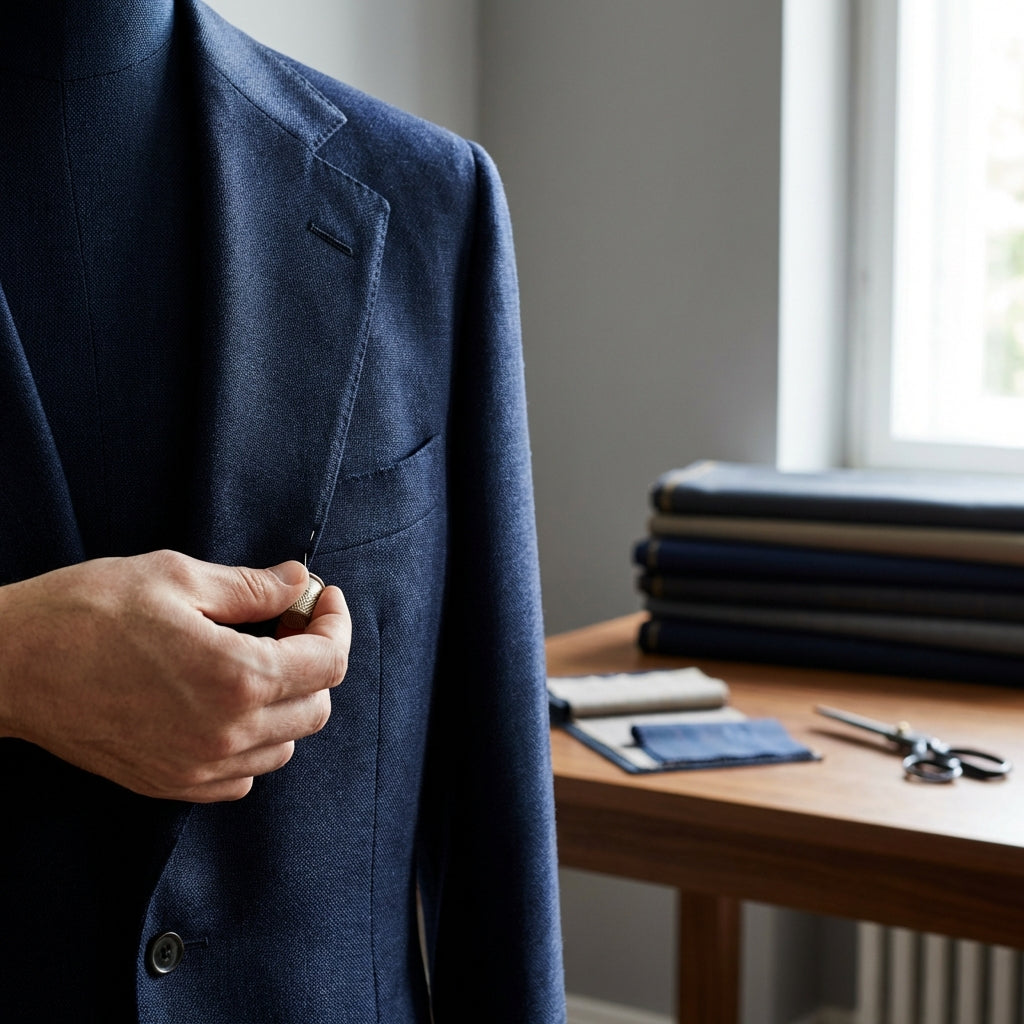
Bespoke construction is hand-stitched throughout. This matters practically and aesthetically. Hand-stitched seams have subtle elasticity that machine stitching lacks, which means they move with the garment rather than restricting it. Hand-finished buttonholes have a refined appearance that machine-finished holes don't replicate. Internal work like pad stitching, which anchors the chest canvas to the garment body, uses hand labor to create subtle sculpting that supports your specific frame.
Fabric sourcing also diverges. Off-the-rack makers select fabrics that work reasonably well across a broad range of frames and movements. Bespoke tailors can recommend fabrics specifically for your body and use case. A fabric that's excellent on a lean frame might not be ideal for someone with a larger build. A tailor who knows your proportions can guide you toward optimal choices.
The tangible outcome is garment longevity. A bespoke suit, handled with reasonable care, often remains wearable and current for a decade. An off-the-rack suit, even from a premium maker, typically feels dated or worn after five to seven years. This isn't always about physical deterioration; it's about shift in silhouette expectations, small creases developing at stress points, and the cumulative effect of compromises in the foundational fit.
The Authority Factor: Wearing Confidence
How you wear a suit matters as much as the suit itself. A poorly fitting garment undermines your physical presence and your psychological state. You're hyperaware of the discomfort, consciously adjusting your posture to accommodate it, mentally distracted by the sensation that something isn't quite right.
A perfectly fitting suit operates invisibly. Your mind is free to focus on what you're saying and doing, not on how you're clothed. That mental bandwidth translates into confidence that other people perceive.
This is what wearing authority means. It's not arrogance or performance. It's the quiet certainty that comes from knowing you're showing up the way you're expected to, without distraction or doubt. Your appearance isn't broadcasting uncertainty or lack of preparation. It's reinforcing competence.
Executives who choose bespoke consistently report this shift. In their first custom suit, they experience fit so precise that it feels like a second skin. The sensation is jarring because they've never experienced it before in ready-made clothing. The difference isn't subtle. It's physical and psychological.
Over time, this becomes the baseline expectation. Wearing bespoke makes going back to off-the-rack feel inadequate. You notice every compromise: the way the jacket sits slightly off your shoulder, the sensation of the sleeve constraining your movement, the awareness that the break isn't quite right.
You stop thinking about it becomes the goal. When you stop thinking about whether your suit fits and start thinking only about what you're communicating, the investment in precision has paid for itself in presence alone.
Personalization and Unique Design
Bespoke tailoring provides creative control that off-the-rack cannot approach. You decide the lapel style: narrow, standard, or wide, and all informed by your shoulder breadth and the balance of your frame. You choose button stance: three-button, two-button, or functional versus decorative buttons. You select pocket configuration: regular jetted pockets, flapped pockets, or ticket pockets, based on your use case and aesthetic preference.
Lining selections range from subtle to distinctive. Some executives prefer traditional silk linings; others choose patterned or colored linings as a private detail visible only when the jacket is unbuttoned. Button choices, thread color, lapel shape, and dozens of other variables are yours to define.
This level of personalization serves a practical purpose beyond aesthetics. A suit designed around your preferences and your professional context performs better because it's actually built for what you do. An executive who meetings predominantly in formal settings can refine their bespoke suit toward that context. One who moves between corporate and creative environments can optimize differently.
Off-the-rack offers fixed choices. Manufacturers may offer two or three button configurations and a range of colors, but the fundamental variables are decided for you. You're selecting from options, not designing your suit. The personalization ceiling is low.
For executives who value precision and intentionality in every domain of their professional life, this design control matters. Your suit reflects your choices, not a designer's assumptions about what most people want.
When Off-the-Rack Falls Short
Off-the-rack fails most obviously when your body doesn't align with standard proportions. If you're unusually tall or short, have broad shoulders relative to your hip width, carry your weight in your midsection, or have any asymmetry between sides of your body, off-the-rack becomes a compromise hunt.
You spend time shopping, find something close, invest in tailoring, get a jacket that feels slightly off, and accept it because the alternative is starting over. Most executives in this situation own suits that don't quite work and wear them anyway because they're tired of searching.

Off-the-rack also falls short for executives with rigorous standards around appearance. If you care enough to notice fit discrepancies, if you understand how proportion should work, if you expect details to be correct, then ready-made will frustrate you repeatedly. You'll see what could be better, and that awareness won't diminish over time.
A third failure point is consistency. If you own multiple off-the-rack suits from different brands, each will fit differently because each was designed on different foundational assumptions. Your closet becomes a collection of compromises rather than a coordinated wardrobe. Getting dressed becomes a calculation about which suit's fit problems you're willing to manage that day.
Bespoke solves each of these problems. Non-standard proportions become the design specification, not a tailoring challenge. Precision becomes the expectation, not the exception. A wardrobe of bespoke suits, built by the same tailor, feels cohesive and refined because every garment was constructed with the same care toward your specific frame.
Consider: If you've experienced any of these frustrations regularly, off-the-rack limitations aren't marginal. They're chronic.
Why Executives Choose Bespoke
The executives who commit to bespoke tailoring share a common operating principle: precision matters. They don't accept approximation in areas where better is possible.
This mindset isn't about snobbery or fashion obsession. It's about standards. An executive who demands rigorous analysis from their financial team, detailed planning in strategy work, and excellence in execution naturally applies the same standard to personal presentation. If you're going to invest time in how you appear, you invest properly.
Donovan England serves this client base because the service model aligns with executive expectations. The 23-point body analysis mirrors the analytical rigor these professionals apply elsewhere. The streamlined process respects their time. The quarterly wardrobe update recommendations mean you're recalibrating your professional presence consistently without needing to think about it. Premium Italian fabric sourcing provides quality material without requiring you to become an expert in textile properties. Hand-stitched craftsmanship delivers the precision construction that precision measurement demands.
The executive who chooses bespoke is saying: I'm serious about my professional presence, I understand that precision is worth the investment, and I want the outcome to match my standards elsewhere.
Second, bespoke creates efficiency paradoxically. Yes, it takes longer upfront. But over years, you build a curated wardrobe of garments that all work together and fit perfectly. Getting dressed becomes easier because you're not managing compromise. You're selecting from quality options that all function at a high level. The mental load of "does this fit right?" disappears. You move faster in the morning and you feel more confident while you're doing it.
Third, executives choose bespoke because they understand sunk cost should serve them, not constrain them. A $1,200 off-the-rack suit is a sunk cost you wear uncertainly for three years. A $3,500 bespoke suit is an investment you wear with certainty and confidence for eight. The second choice is financially and psychologically superior.
Recalibrating Your Professional Presence
If you're reading this, you've likely experienced the friction of off-the-rack limitations. You know what it feels like to wear something that doesn't fit the way it should. You're aware of the gap between how you want to show up and how your wardrobe is currently allowing you to.
Bespoke tailoring is how you close that gap. It's not a luxury indulgence. It's the solution for an executive who understands that precision in appearance reinforces precision in execution.
The path forward is straightforward. Schedule a consultation with a bespoke tailor who understands your context and your standards. Explain what you need: an executive wardrobe built to your precise measurements and optimized for your professional environment. Go through the measurement and analysis process seriously. You're not just being measured; your proportions are being documented so that every future garment starts from an accurate foundation.
Design your first suit with intention. Choose fabric that serves your climate and context. Decide on style details that feel authentically you. Order a custom try-on so you can validate fit before final construction. Be involved in revisions. You're not decorating a suit; you're engineering one.
When your first bespoke suit arrives and you put it on, notice everything. Notice how it moves with you. Notice the absence of pulling or bunching. Notice how you can button it without consciousness of the action. Notice how the break sits over your shoe, how your shoulders feel unrestricted, how the sleeve hits your wrist exactly. You're experiencing the difference between accommodation and precision.
Build from there. A professional wardrobe isn't built overnight. It's built suit by suit, season by season. Your next suit can be different: perhaps a different color, a different weight fabric, a different context. But each one is built on the same foundation of measurement and care.
Within two years, you'll own a curated collection of perfectly fitting garments. Getting dressed becomes effortless. Your professional presence solidifies. The confidence you gain isn't about the clothes. It's about knowing that you're showing up exactly as you intend.
That's the executive choice.
Schedule your Complementary Wardrobe Review Call