Cart
0

Why Executives Choose Between Bespoke and Mass-Produced Options
Bespoke Suits vs Off-the-Rack: Which Delivers Professional Confidence
The choice between bespoke and off-the-rack clothing shapes how you show up at work. For executives and high-achieving professionals, this isn't a fashion question. It's a strategic one. Your wardrobe either amplifies your authority or undermines it, and the difference between a suit that fits and one that merely hangs on your frame can shift how clients, colleagues, and boardrooms perceive you before you speak.
This guide examines what separates bespoke tailoring from mass-produced options, where each excels, and how to decide based on your actual professional life, not marketing narratives.
Executives face a practical crossroads. Off-the-rack suits exist everywhere, arrive in days, and cost a fraction of bespoke alternatives. Yet walk into any boardroom and you'll notice something: the people wearing authority don't always wear the newest or most expensive labels. They wear clothes that fit them precisely. This distinction matters because ill-fitting clothing broadcasts struggle, even when the fabric is premium and the label is prestigious.
The tension between bespoke and off-the-rack boils down to expectations. Mass-produced options assume your body matches one of perhaps ten standard proportions. Bespoke tailoring works backward: it starts with your actual measurements and builds the garment around you. For professionals whose time commands high hourly rates, the efficiency and confidence gained from perfect fit often outweighs the premium cost.
Neither approach is inherently superior. The question is alignment: Does your professional environment, schedule, and body type reward one approach more than the other?
The Fit Factor: Precision Body Analysis Versus Standard Sizing
Standard sizing is a statistical average. A size 42 jacket from one brand assumes your shoulder width, sleeve length, chest depth, and torso length match a curve plotted from thousands of bodies. That curve misses particulars. You might have broad shoulders but a shorter torso, or long arms paired with a slighter build. Off-the-rack production accepts these mismatches because tooling for precision would destroy profit margins.
Bespoke tailoring applies a 23-point body analysis to map your proportions with specificity. This process captures shoulder slope, chest contour, armhole depth, and dozens of other measurements that standard tape measures never record. The result isn't a suit that "fits well." It's a suit that moves with your body and responds to your posture the way clothing should.
The practical difference reveals itself in the mirror and in how you move through a day. A well-fitted bespoke jacket allows your arms to hang naturally without riding up at the wrists. The collar sits flush against your neck without gapping when you turn. The length of the jacket proportions to your torso, not to an arbitrary industry standard. You stop thinking about how the suit feels because it doesn't feel like anything. It's just there, responding to you.
Off-the-rack tailoring can address some fit issues. A tailor can shorten sleeves, take in a jacket, or adjust a waistband. But they cannot expand shoulders, deepen an armhole, or adjust a garment's fundamental architecture. Once the jacket is cut, the frame is set.
Confidence Through Craftsmanship: Hand-Stitched Versus Factory Production
A factory-produced suit is efficient. Machines cut dozens of identical pieces per hour, and assembly lines stitch them together using standardized sequences. Quality control catches major defects, but the process prioritizes speed. Seams are straight, buttonholes are uniform, and the suit is functional. It works for casual wear and occasional professional use.
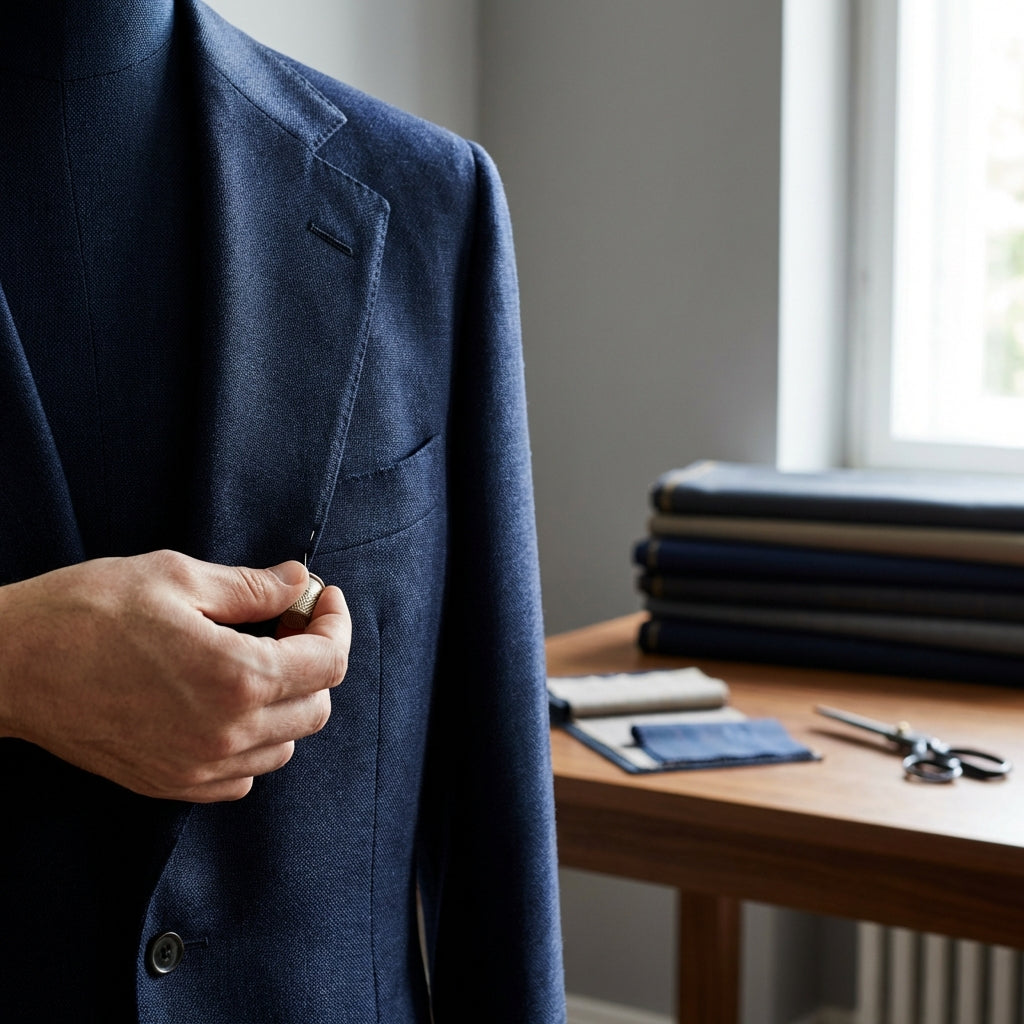
Hand-stitching introduces a different philosophy. A tailor stitches seams that curve and adapt to your specific frame. The lapels are shaped by hand to sit correctly against your chest. Buttons are anchored with reinforcement that machine stitching cannot replicate. The interlining, which determines how a jacket drapes, is chosen and positioned based on your fabric and body type, not a production schedule.

This craftsmanship doesn't equal perfectionism for its own sake. It means the garment is built to accommodate your movement, your climate, and your lifestyle. A hand-stitched jacket will break in around your shoulders in a way that enhances its drape over time, rather than simply wearing out. The lapel roll develops character rather than becoming creased and stiff.
The confidence that emerges from hand-stitched clothing is subtle but real. You sense that someone understood your needs specifically. The jacket isn't trying to be many things to many people. It's engineered for you. That focus compounds over years as the garment molds to your habits and deepens in character.
Investment in Authority: Cost Comparison and Long-Term Value
Off-the-rack suits typically range from $400 to $2,500 depending on the brand and fabric. Bespoke tailoring usually starts around $3,000 and extends well into $5,000 or higher for premium fabrics and experienced craftspeople. The initial price difference is substantial.
Over five years, however, the economics shift. An executive might purchase four to six off-the-rack suits in that period, either because they outgrow them, they wear out from regular use, or they fall out of style rotation. That's $2,400 to $15,000 in cumulative spending. A bespoke suit, properly maintained, will serve you for five to seven years and often longer. With quarterly wardrobe updates built into a bespoke program, you refresh your palette without replacing entire garments.
The hidden cost of off-the-rack isn't just dollars. It's decision fatigue. Browsing inventory, trying on multiple sizes, settling for near-fits, and then hiring a tailor to adjust what doesn't work consumes time. For executives billing their hours at $200 or more, the time invested in a haphazard buying process exceeds the material cost difference.
Bespoke tailoring structures the buying process. You work with a single expert, meet quarterly, and follow a strategic framework rather than impulse. The initial investment is larger, but the total cost of ownership and the elimination of wardrobe mistakes often favors the bespoke approach for professionals who cycle through their clothes regularly.
Customization and Personalization: Tailored Lookbooks Versus Limited Choices
Off-the-rack retail presents choice as infinite until you actually shop. You browse hundreds of styles that exist in perhaps five sizes. Once you narrow to your size, your real options contract to maybe thirty pieces that could work for your body. Color, fabric, pattern, and fit are packaged as a unit. You cannot adjust one without compromising another.
Bespoke customization decouples these elements. You choose your fabric from sources like Italian mills, then select your pattern, pocket style, button composition, and lining separately. A navy suit can have a subtle peak lapel, working cuffs, ticket pockets, and hand-stitched buttonholes that reflect how you actually dress and move. More importantly, you're not choosing from what happened to be manufactured this season. You're building what aligns with your professional identity.
Personalized digital lookbooks take this further. Instead of scattered inspiration images and mental notes, a bespoke service can provide a curated visual guide showing how your new pieces coordinate with what you already own. This removes the guesswork that makes off-the-rack shoppers second-guess their purchases months later.
For executives, this customization isn't indulgence. It's efficiency. You build a cohesive wardrobe system rather than accumulating unrelated pieces. Each item works with others. You know in advance how fabrics will coordinate, how colors will interact under office lighting, and which styles support your professional presence.
The Timeline Reality: Bespoke Lead Times Versus Immediate Gratification
Bespoke tailoring requires patience. From initial consultation through your first fitting, the process typically takes six to eight weeks. Some craftspeople book further out. If you need a suit for an event next week, bespoke cannot help you.
Off-the-rack offers immediate access. You can purchase online and have a suit in three days, or walk into a store, try on, and leave with a jacket that afternoon. For professionals who value speed, this is the decisive advantage.

The practical reality is more nuanced. Executives rarely face true emergencies. Most professional events are planned weeks in advance. Bespoke timelines fit actual planning cycles if you structure your wardrobe strategy quarterly rather than reactively. The delay becomes irrelevant when it's aligned with how you actually buy.
That said, bespoke timelines do create a different shopping rhythm. You cannot impulse-purchase. You must commit to your choices before you wear the garment. For some professionals, this forces better decision-making. For others accustomed to browsing and trying on, it feels restrictive.
The middle path is maintaining a rotation of existing bespoke pieces while planning future additions ahead of need. This balances the speed of off-the-rack with the precision of custom tailoring.
Material Quality: Premium Italian Fabrics Versus Commercial Textiles
Off-the-rack brands optimize for margin. A suit might use good fabric, but the sourcing prioritizes availability and cost. Most mass-market suiting comes from reliable mills but isn't selected for individual characteristics. It's functional and consistent, which is sometimes exactly what you need.
Bespoke tailoring partners directly with premium mills, often Italian or British suppliers known for heritage and specificity. These fabrics offer weight, texture, and hand-feel that reveal themselves in wear. A premium worsted responds differently to humidity than a commercial blend. The weave creates a visual depth that photographs and feels substantial under your palm.
This distinction matters most in professional settings where people interact with you closely. In a conference room or during a client dinner, the quality of your fabric is palpable. It influences how seriously your presence is registered, not consciously but subliminally.
The tradeoff is cost and maintenance. Premium fabrics often require dry-cleaning or careful home care. They may be less forgiving of stains or wear patterns. Off-the-rack suiting, blended with synthetics, often withstands more abuse and requires less specialized care.
For executives whose clothes represent their professional brand, premium Italian fabrics justify the investment. For those in more casual professional environments or who prefer lower-maintenance wardrobes, commercial textiles serve perfectly well.
Service Experience: Expert-Led Process Versus Self-Navigation
Buying off-the-rack relies on your own judgment and retail staff who may have varying expertise. You research online, assess sizing charts, try on options, and make decisions based on how each piece looks in the dressing room mirror. The process emphasizes independence and speed but assumes you understand fit, proportion, and how to evaluate quality across brands.
Bespoke services invert this dynamic. An expert leads the process. They assess your body, discuss your professional environment, understand your existing wardrobe, and guide you toward choices that serve you rather than trending ideas. The expertise you're paying for isn't just craftsmanship. It's strategic counsel about what will work for your life.
This guidance has underestimated value. A professional stylist can identify proportions you've never considered. They might suggest a fabric you'd never select on your own but that transforms how you look. They catch mistakes before they're sewn, not after you've owned the garment for months.
The trade-off is loss of autonomy. You're collaborating with someone else's vision rather than executing your own. For executives accustomed to controlling every decision, this can feel uncomfortable initially. For those overwhelmed by wardrobe choices, it's liberation.
Longevity and Wardrobe Evolution: Quarterly Updates Versus Static Closets

An off-the-rack wardrobe doesn't evolve. You buy a suit and wear it until it's outdated, worn out, or you've outgrown it. Then you repeat the buying process, often making similar mistakes as before because the underlying fit issues aren't addressed.
Bespoke relationships support ongoing development. Quarterly wardrobe recommendations mean you're regularly evaluating what you wear and what gaps exist. This rhythm creates accountability. Instead of accumulating unworn pieces, you intentionally rotate and refresh based on seasonal needs and professional demands.
Over several years, this approach produces a coherent wardrobe system. Your fabrics coordinate. Your silhouettes complement each other. You understand your tastes deeply enough to make faster decisions. New pieces integrate seamlessly rather than existing as isolated acquisitions.
The quarterly touchpoint also captures changes in your body. Most professionals experience some physical evolution through their careers: weight gain, muscle development, postural shifts. Bespoke tailoring accommodates these naturally. Your tailor adjusts slightly as needed, whereas off-the-rack cycling forces you to start over with size recalibration every few years.
Making Your Decision: Which Approach Suits Your Professional Life
Choose bespoke if your professional presence justifies the investment. If you're in roles where client interaction, boardroom visibility, or persuasion influence outcomes, the precision fit and customization create measurable value. Choose bespoke if you work regularly or plan to, because the cost per wear drops over time and the wardrobe management becomes simplified rather than more complex.
Choose off-the-rack if your role emphasizes functionality over perception, if your environment accepts variance in formality, or if you prefer flexibility and lower financial commitment. Choose off-the-rack if you genuinely enjoy browsing and trying on, because that process becomes friction rather than pleasure in a bespoke model.
Consider a hybrid approach: invest in one or two bespoke foundation pieces while building the rest through thoughtful off-the-rack purchases. A perfectly fitted bespoke blazer can anchor a wardrobe for years, and you can experiment with off-the-rack trousers and shirts as you learn your preferences.
The decision ultimately reflects your professional reality, not fashion philosophy. If your clothes shape how others perceive your authority, bespoke tailoring delivers precision that off-the-rack cannot match. If your environment and schedule reward efficiency and flexibility more than perception, off-the-rack serves adequately. Honest self-assessment about which factors actually move outcomes in your career makes the choice clear.
Recalibrating Your Wardrobe Strategy
Most executives reach a point where their existing wardrobe no longer serves them. Clothes that fit five years ago don't fit now. Styles that worked for one role feel wrong in another. The suit you've worn a hundred times is finally wearing out, and the thought of shopping again feels exhausting. This moment is an opportunity to recalibrate rather than repeat past patterns.
Recalibrating means deciding what you need to show up the way you're expected in your current role. It means measuring the cost of wardrobe mistakes against the cost of expert guidance. It means building a system instead of accumulating pieces.
For professionals ready to stop thinking about getting dressed and start showing up with quiet confidence, a bespoke approach removes the friction. Donovan England specializes in this exact transition, using a 23-point body analysis and streamlined quarterly updates to transform how executives experience their professional wardrobes. The process is precise, the craftsmanship is meticulous, and the result is authority that registers without announcement.
The choice between bespoke and off-the-rack isn't about spending more money. It's about allocating resources toward what actually matters in your professional life. If wardrobe decisions consume your attention, if fit issues undermine your confidence, or if you're cycling through suits without real progress, that's the signal that precision beats speed. If you're content with how you currently dress and value flexibility, off-the-rack remains a sensible path.
The best choice is the one that lets you stop worrying about what you're wearing and start focusing on what you're actually doing.
Schedule your Complementary Wardrobe Review Call